
1. Introduction
- English is a global language. Whether you’re traveling, working, or studying, being able to communicate in English opens up a world of opportunities.
- Understanding grammar is vital for effective speaking. It helps you convey your thoughts clearly and be understood by others.
- Many learners face challenges, like remembering rules, distinguishing between tenses, or knowing when to use certain verbs. It can be overwhelming at first!
- However, knowing grammar can significantly improve your conversation skills, making your interactions more fluent and confident.
2. The Foundations of English Grammar
Definition of Grammar
- Grammar consists of the rules that govern how we combine words into phrases and sentences. It ensures our communication is coherent and precise.
- While grammar might be perceived as more essential in writing, it’s crucial for speaking too, as it helps you formulate clear and logical sentences on the fly.
Core Components of Grammar
- Parts of Speech: The building blocks of grammar include nouns (e.g., “dog”), verbs (e.g., “run”), and adjectives (e.g., “happy”).
- Sentence Structure: The basic structure typically follows a Subject-Verb-Object format, such as “I (subject) eat (verb) apples (object).” Understanding this layout helps with coherent speech.
3. Understanding Tenses
What are Tenses?
- Tenses denote the time of an action or event. Mastering tenses is essential for expressing when something happens: past, present, or future.
Types of Tenses with Examples
Present Tenses:
- Present Simple: “I eat breakfast.”
- Present Continuous: “I am eating breakfast.”
- Present Perfect: “I have eaten breakfast.”
- Present Perfect Continuous: “I have been eating breakfast.”
Past Tenses:
- Past Simple: “I ate breakfast.”
- Past Continuous: “I was eating breakfast.”
- Past Perfect: “I had eaten breakfast.”
- Past Perfect Continuous: “I had been eating breakfast.”
Future Tenses:
- Future Simple: “I will eat breakfast.”
- Future Continuous: “I will be eating breakfast.”
- Future Perfect: “I will have eaten breakfast.”
- Future Perfect Continuous: “I will have been eating breakfast.”
How to Identify and Use Tenses in Sentences
- To choose the correct tense, consider when the action takes place. Is it happening now, in the past, or scheduled for the future?
4. Auxiliary Verbs: The Backbone of Sentences
Definition and Importance
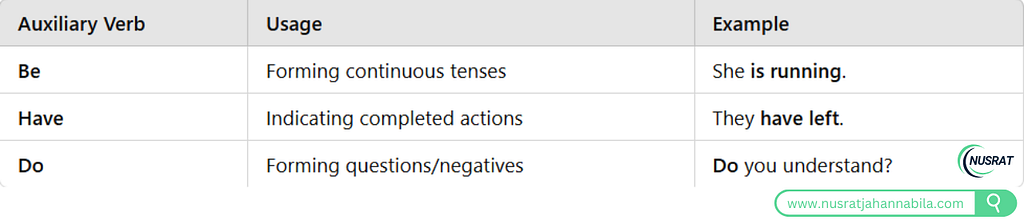
- Auxiliary verbs, often called helping verbs, assist the main verb in a sentence, clarifying the time and mood.
Common Auxiliary Verbs
- Examples include “be,” “have,” “do,” “will,” and “can.”
Table of Auxiliary Verbs with Examples
Common Mistakes with Auxiliary Verbs
- Mix-ups often occur, like using “is” instead of “are” when should be plural, or omitting auxiliary verbs in questions.
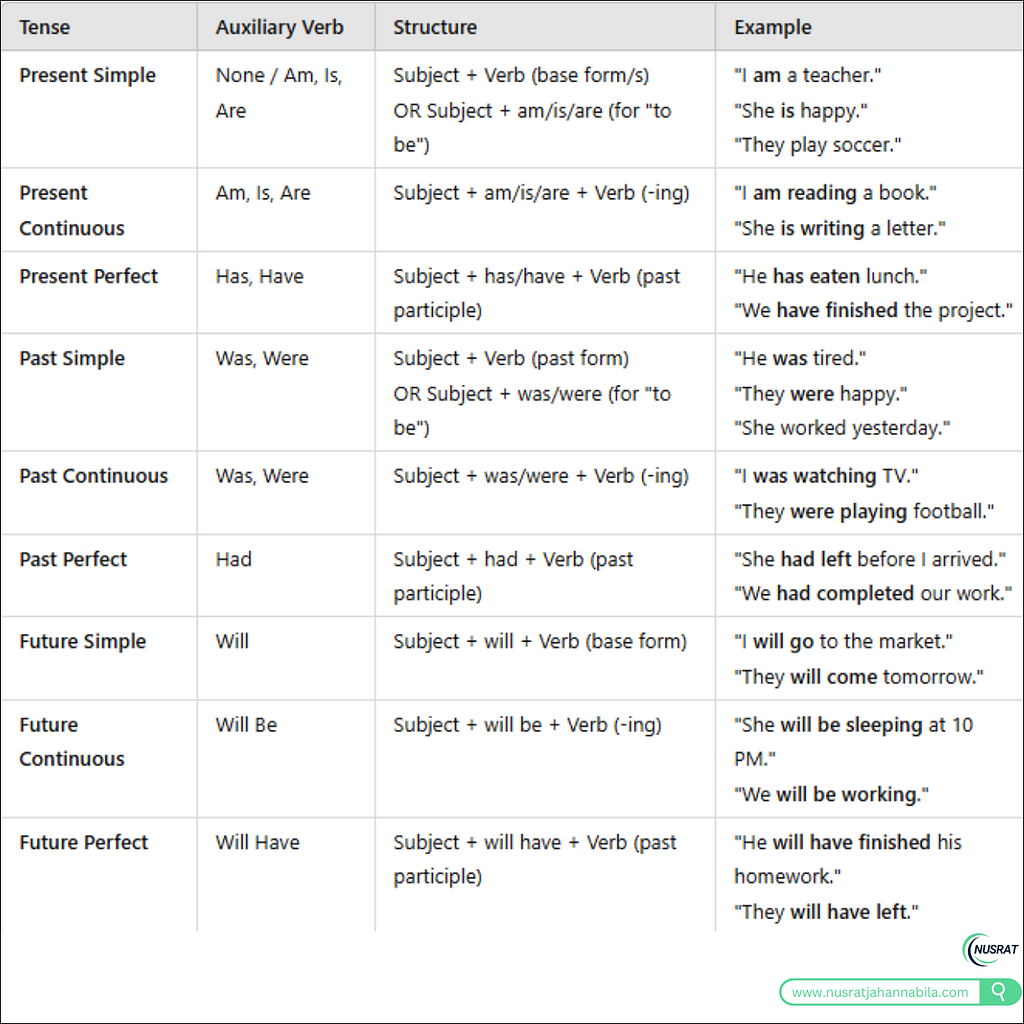
Here’s a comprehensive table using all auxiliary verbs (am, is, are, was, were, have, had, will) across various tenses with easy examples:
5. Verb Forms (V1, V2, V3)
Introduction to Verb Forms
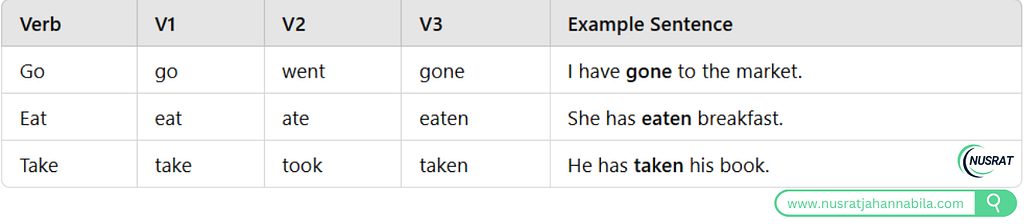
- Understanding verb forms is essential: V1 (base form), V2 (past simple), and V3 (past participle).
Table of Common Verbs
How to Memorize Verb Forms Easily
- Use flashcards, sing along to songs, or practice with repetitive exercises to help reinforce your memory.
6. Using “To” and “Be” in Sentences
Understanding “To”
- “To” is often part of the infinitive form of a verb (e.g., “to read”) and is used to express purpose or direction (e.g., “I go to school.”).
Understanding “Be”
- The verb “be” describes states or conditions (e.g., “I am happy”) and is employed in forming continuous tenses (e.g., “She is studying.”).
Examples of “To” and “Be” Together
- “I want to be a doctor.”
- “They need to be on time.”
7. Commonly Confused Words
Words with Similar Meanings
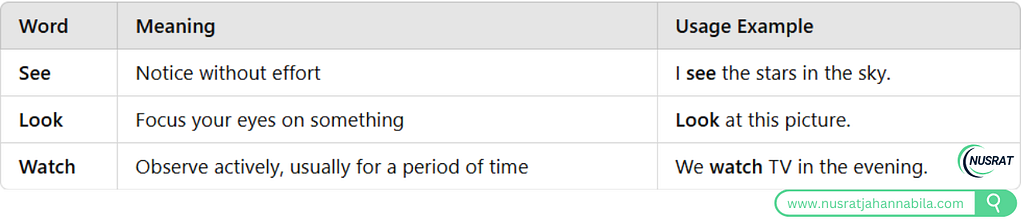
- See = When you notice something without trying.
- Look = When you intentionally focus on something.
- Watch = When you observe something for a longer time, often to see what happens.
“See,” “Look,” and “Watch”
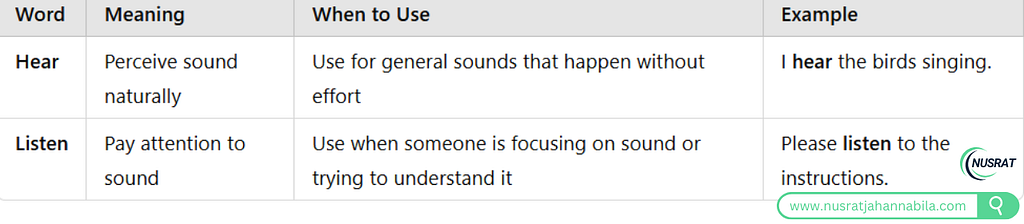
“Hear” vs. “Listen”
- Hear = Sounds that come to you without effort (passive).
- Listen = Paying attention to sounds (active).
“Say,” “Tell,” and “Speak”
- Hear = Sounds that come to you without effort (passive).
- Listen = Paying attention to sounds (active).
8. Mastering Sentence Structures
Basic Sentence Structure
- The foundation of a sentence is often structured as Subject + Verb + Object: “I read books.”
Complex Sentences
- Complexity increases with conjunctions, such as “and,” “but,” “because.” For example: “I read books because I enjoy learning.”
How to Build Sentences Step by Step
- Start with simple sentences. Gradually add adjectives and adverbs for more detail and expression.
9. Tips for Learning English Grammar
- Daily Practice
- Set aside 20–30 minutes for grammar exercises each day.
- Interactive Tools
- Leverage apps like Duolingo, Grammarly, or Memrise for a fun way to learn.

- Learning Through Entertainment
- Immersing yourself in English through movies, songs, and stories can enhance your learning experience.
- Speaking Practice
- Join English conversation groups or find a language partner to practice speaking.
- Using Visual Aids
- Tables, flowcharts, and diagrams can help organize grammar concepts visually.
10. Visual Aids for Grammar Learning
- Tables for Verb Forms and Tenses
- Consider creating a chart that outlines all the tenses alongside examples.
- Graphs
- Use a line graph to illustrate your fluency progress over time.
- Pictures and Flowcharts
- A flowchart that outlines how continuous tenses are formed can be a helpful resource.
11. Avoiding Common Grammar Mistakes
- Watch for common pitfalls, such as mixing up tenses or forgetting auxiliary verbs. Pay close attention to similar words like “say” and “tell,” ensuring you’re using them correctly.
12. Making Grammar Fun
- Engage in word games and puzzles to make learning enjoyable.
- Explore English-speaking apps that incorporate rewards and challenges.
- Setting realistic goals helps track your progress while also keeping you motivated.
13. Conclusion
- Mastering grammar is pivotal for effective speaking in English. Consistency through daily practice and interactive methods will lead you to success in your learning journey.
- Remember, patience is key. Celebrate small victories along the way and enjoy the process of learning!